


How to Choose an Offshore Customer Support Team That Drives Results
- BPO
- 198 Views
How to choose an offshore customer support team that drives results: five factors to evaluate, a provider scorecard, red flags, and the KPIs to track.
Offshore customer support team
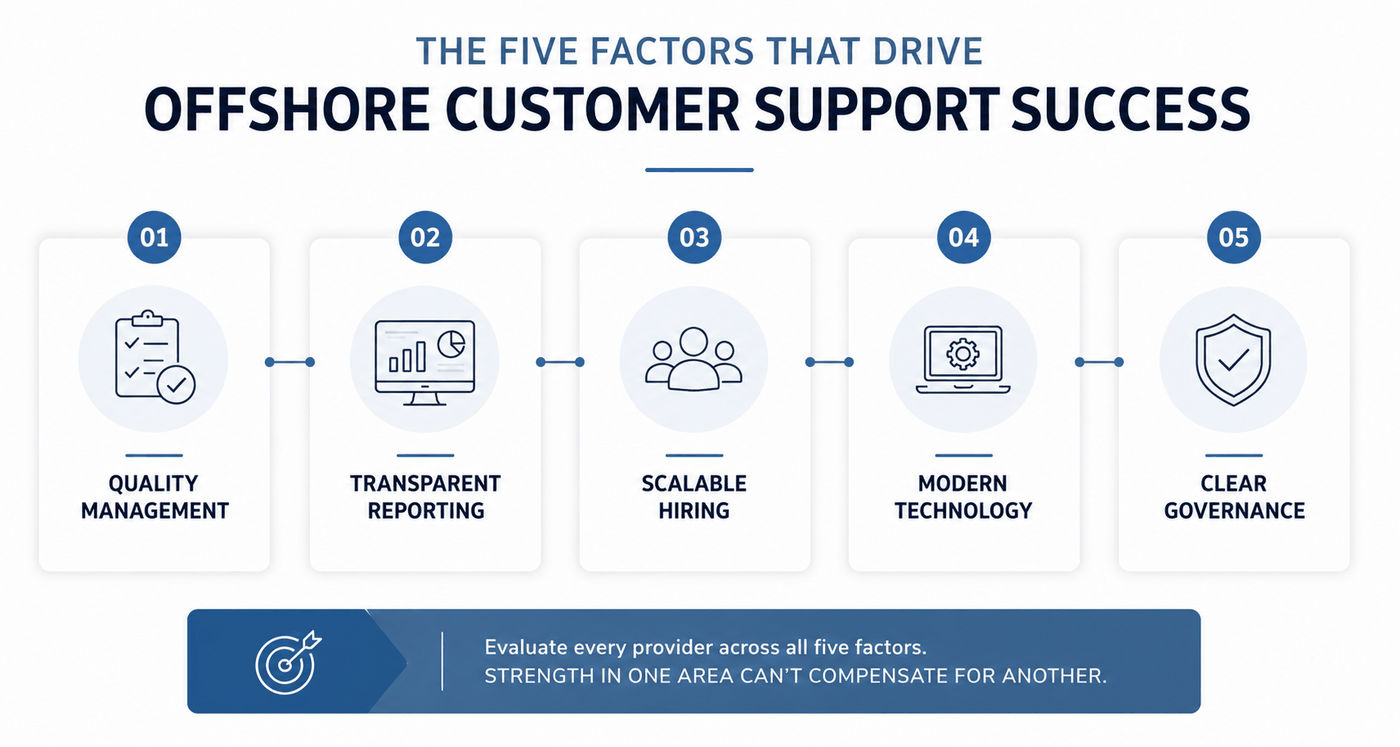
Choosing an offshore customer support team that drives results means evaluating five factors: strong quality assurance, transparent reporting, scalable hiring, modern technology, and clear governance.
These elements determine whether a partnership actually improves customer experience. Skip any one of these and the partnership tends to underperform within the first six months, even if the price looked right on paper.
What Should You Define Before Comparing Offshore Providers?
Before requesting proposals, define what good actually looks like. Vague goals like ‘better service’ produce vague results.
Start with your customer experience objectives, whether that means reducing churn or lifting Net Promoter Score (NPS), a survey-based metric that measures how likely customers are to recommend your business.
Customer experience influences far more than satisfaction scores. Harvard Business Review’s research on customer retention found that increasing customer retention rates by just 5 percent can increase profits by 25 to 95 percent. This is exactly the kind of outcome a well-chosen BPO partner should be helping you protect.
| Planning area | Question to answer before you contact vendors |
|---|---|
| CX goals | Are you reducing churn, lifting NPS, or both? |
| Service levels | What response times and resolution windows are acceptable? |
| Coverage | What hours and time zones need support? |
| Growth | Will headcount need to double within two years? |
A provider that fits your current size may not scale when your customer base doubles, so weigh growth plans as heavily as today’s volume.
How Do You Evaluate an Offshore Team’s Operational Expertise?
Ask candidates whether they have supported companies in your sector, and look for specific examples instead of broad assurances. Centers with rigorous hiring screens consistently outperform those that prioritize speed over fit.
Agent training programs deserve scrutiny, too. Most reputable providers run onboarding over two to four weeks, followed by certification before agents handle live interactions unsupervised.
A dedicated team works exclusively on your account, while a shared team splits time across multiple clients. Dedicated teams cost more but typically deliver faster ramp-up and stronger brand consistency.
If you serve international markets, ask how the provider builds and manages multilingual teams. Effective multilingual support depends on consistent hiring standards, language-specific training, and quality monitoring across every language offered.
According to McKinsey's 2024 global survey of customer care executives, more than half of companies already outsource part of their customer care operations, and nearly half expect to expand that further within two years.
Outsourcing has moved from backup plan to core operating strategy, which raises the bar for who gets chosen.
How Can You Evaluate an Offshore Team’s Quality Management Process?
Look for a quality management process that measures performance consistently and uses the findings to improve agent performance over time.
A quality assurance (QA) program is the set of methods a provider uses to review, score, and improve agent interactions on an ongoing basis. Ask how their sampling works, who reviews interactions, and how scores get calibrated across teams.
Performance monitoring should be continuous, with real-time insights informing regular coaching and performance improvements. Workforce management (WFM), the discipline of forecasting demand and scheduling staff, should feed real-time adherence data back into coaching.
This rigor matters because the industry is struggling here. Forrester's 2024 US Customer Experience Index found that CX quality across American brands declined for a third consecutive year, with effectiveness and ease scores both falling.
Partners with disciplined QA are the exception keeping brands out of that trend.
What Technology Should an Offshore Customer Support Provider Have?
An offshore customer support provider should offer integrated CRM systems, omnichannel support, AI-assisted tools, and secure infrastructure that can scale with your business.
CRM and help desk integrations should be seamless, avoiding lengthy implementation projects.
Omnichannel support, the ability to handle chat, email, and phone within one unified customer record, has become an essential capability for delivering consistent customer experiences.
AI-powered customer support tools are reshaping the contact center, but adoption alone proves nothing. Gartner predicts that by 2029, agentic AI will autonomously resolve 80 percent of common customer service issues without human intervention, cutting operational costs by 30 percent.
PwC's 2025 Customer Experience Survey found that 86 percent of consumers still say human interaction is moderately or very important to their overall brand experience, even as AI usage grows.
The providers worth hiring use AI to support agents while preserving the human judgment customers continue to value. You’ll also need to confirm data security certifications relevant to your industry and how client data is segmented.
How Do You Compare Two Offshore Customer Support Providers?
Side-by-side evaluation works best when you score each provider against the same criteria rather than comparing impressions from separate sales calls. The scorecard below summarizes the core areas that deserve attention during the selection process.
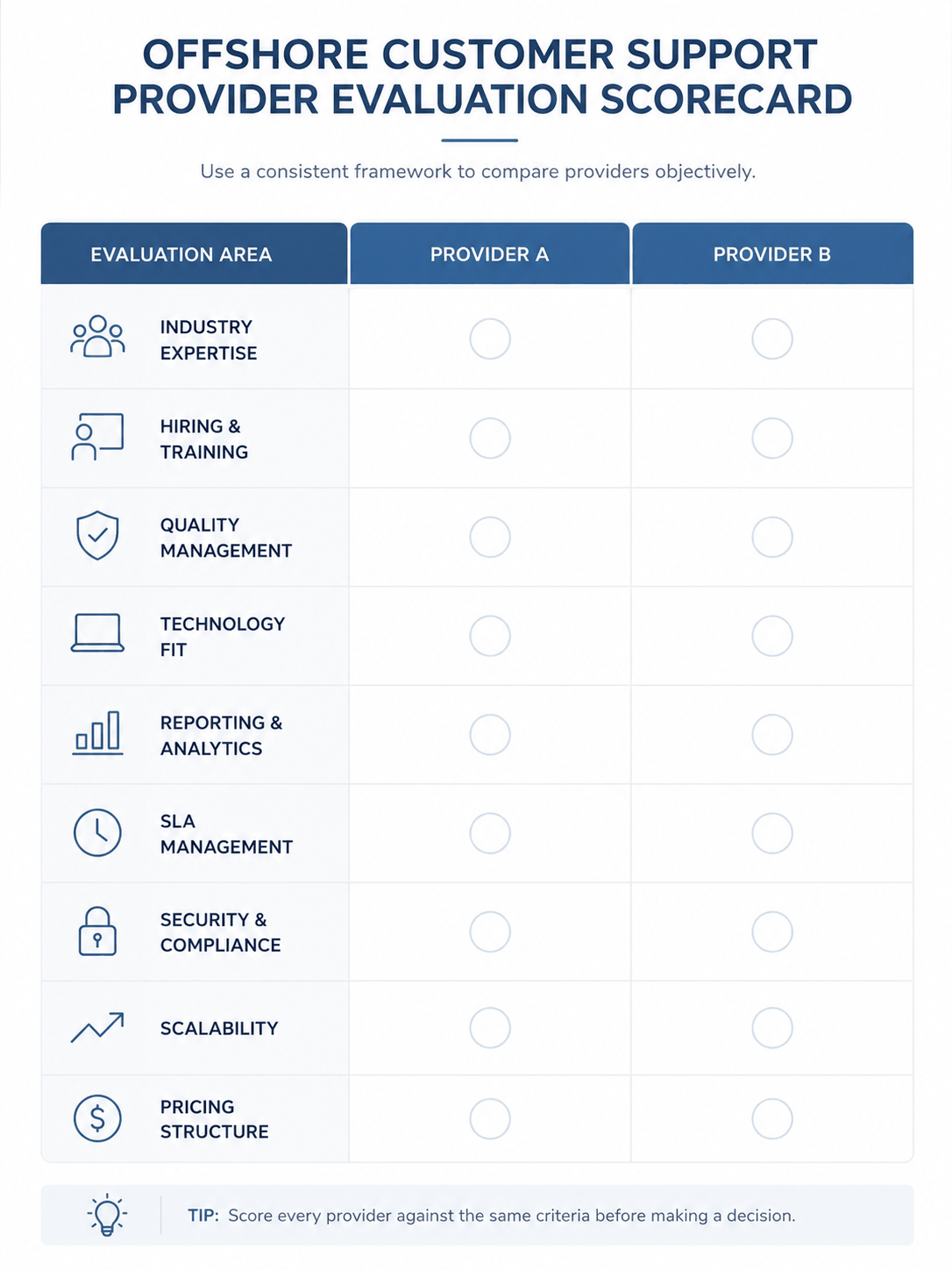
- Hiring and training, including candidate screening and certification before live calls.
- Quality management, including sampling methodology and scoring calibration.
- Technology fit, including supported platforms and the use of AI tools.
- Reporting cadence, including whether dashboards are real-time or batched.
- Pricing structure, including whether quotes are fully loaded or carry hidden fees.
What Are Red Flags When Choosing an Offshore Customer Support Provider?
These warning signs tend to predict a disappointing partnership before the contract is even signed:
- Vague answers about attrition rates, since providers confident in their retention numbers share them without hesitation.
- Reluctance to provide reference clients in your industry, which suggests limited relevant experience.
- Pricing well below the regional market average, which may indicate underpaid agents, higher turnover, or unrealistic pricing assumptions.
- Unwillingness to commit to specific SLAs in writing, which signals accountability will be a future negotiation rather than a current guarantee.
Common Mistakes Companies Make When Choosing an Offshore Partner
The same five mistakes show up again and again, and each one is avoidable with the right due diligence upfront.
- Choosing based on cost alone, which is the most expensive mistake in offshore sourcing, since the cheapest hourly rate often hides higher attrition and weaker training.
- Ignoring cultural alignment, which creates friction that shows up in customer interactions long before it appears in performance reports.
- Overlooking governance, which leaves both sides guessing about accountability when challenges arise.
- Focusing only on response times, when customer satisfaction also depends on issue resolution, communication quality, and the overall support experience.
- Underestimating onboarding, since a rushed launch often leads to avoidable setbacks, longer stabilization periods, and additional work for both teams.
What Performance Metrics Should You Track?
Not every metric deserves equal weight. The table below summarizes what each one measures and the pitfall to watch for.
| Metric | What it measures | Watch out for |
|---|---|---|
| CSAT | How customers feel right after an interaction | Best read alongside other indicators, not alone |
| FCR | Share of issues solved without a follow-up contact | Strongly correlates with both satisfaction and lower cost |
| SLA Adherence | Whether agreed targets are met consistently | Hitting every SLA while customers stay frustrated misses the point |
| QA Score | Interaction quality against defined standards | Should move with CSAT, and divergence signals a methodology problem |
| AHT | Average time spent per interaction | Over-optimizing for speed pushes agents toward rushed, lower-quality resolutions |
| Escalation rate | How often agents hand off beyond their authority | A rising rate often signals a training gap |
| Retention | Agent and customer turnover | Disrupts institutional knowledge in ways that eventually reach customers |
Retention is worth dwelling on, since it ties every other metric together. Contact center turnover disrupts institutional knowledge, and that disruption eventually reaches your customers no matter how strong the technology is underneath it.
Frequently Asked Questions About Offshore Customer Support
What are the key factors to consider when vetting offshore customer support providers?
Operational expertise, quality management, technology, scalability, and governance together. No single factor compensates for weakness in another.
When is the right time to consider outsourcing customer support offshore?
Most companies consider it when ticket volume outpaces hiring capacity, when new time zones or languages are needed, or when leadership wants internal teams freed for higher-value work.
What KPIs should I look for when evaluating an offshore support team?
Prioritize FCR, CSAT, SLA adherence, and agent retention. Together, these four paint a far more accurate picture than any single metric alone.
How can I evaluate an offshore team’s technical proficiency and problem-solving abilities?
Request live demonstrations, review sample QA scorecards, and ask for references from clients with comparable complexity.
Why is cultural alignment important when choosing an offshore customer support partner?
Tone and problem-solving style shape how customers experience your brand, and misalignment creates friction that metrics alone often miss.
How many agents should a company start with when launching an offshore support team?
Most pilots launch with five to fifteen agents, enough to validate quality and processes before scaling further.
Choosing the Right Offshore Customer Support Team
Companies that choose offshore customer support teams based on operational maturity, governance, quality management, and scalability consistently achieve stronger customer experience outcomes than those focused primarily on cost.
Centro brings operational maturity, rigorous quality management, and proven scalability to every client partnership, built to help businesses grow without compromising customer experience.
Contact the Centro team today to start the conversation.